 Save
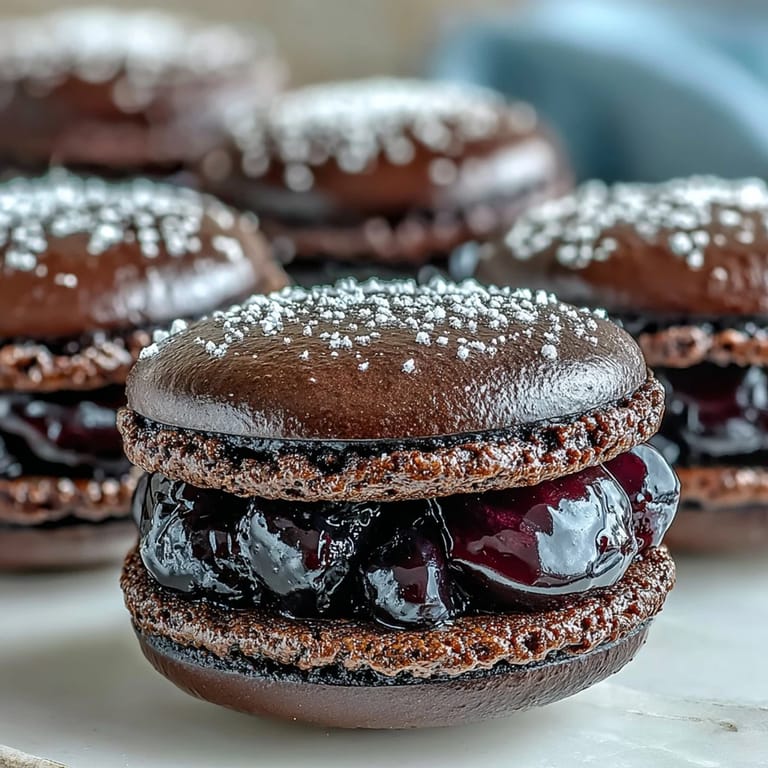
Save The first time I attempted macarons, I was convinced they were impossible—until a friend casually mentioned she'd been aging her egg whites in the fridge like they were fine wine. That small detail changed everything. Now when I make these black currant shells, I'm always struck by how something so delicate and French can come together in your own kitchen with just patience and the right technique. There's something almost magical about watching the meringue transform into glossy peaks, then folding it into almond flour until it flows like lava. These aren't just cookies; they're a small edible proof that precision and care actually matter.
I'll never forget bringing a box of these to a dinner party where someone mentioned they'd only ever had macarons from Paris. The moment they bit into one, their entire face softened. That's when I realized these little cookies had become my quiet way of telling people I'd spent time thinking about them, that I cared enough to get the technique right. It was less about French technique and more about love translated into sugar and almond.
Ingredients
- Aged egg whites (120 g): This is non-negotiable—sit them uncovered in the fridge for 24–48 hours so they break down slightly and create a more stable meringue that won't deflate.
- Powdered sugar and almond flour (200 g and 120 g): Pulse them together in a food processor until they're incredibly fine, then sift to catch any grittiness that would ruin your smooth shells.
- Granulated sugar (100 g): This goes into the meringue gradually while beating; it's what gives you those stiff, glossy peaks that hold their shape.
- Salt (pinch): A tiny amount stabilizes the egg whites and brings out the almond flavor without announcing itself.
- Gel food coloring (optional): Use gel, never liquid—liquid adds moisture and throws off your ratios.
- Blackcurrant purée (100 g): Strain it through a fine sieve to remove seeds; the bright, tart flavor is what makes these macarons sing.
- White chocolate (120 g): Chop it finely so it melts evenly when the hot purée hits it—uneven melting means a grainy ganache.
- Unsalted butter and lemon juice: The butter smooths out the ganache texture, while the lemon juice adds a whisper of brightness that plays beautifully with the black currant.
Tired of Takeout? 🥡
Get 10 meals you can make faster than delivery arrives. Seriously.
One email. No spam. Unsubscribe anytime.
Instructions
- Prepare your workspace:
- Line baking sheets with parchment paper or silicone mats—this is your safety net so the shells release cleanly. Make sure your mixing bowl and all equipment are completely grease-free; even a trace of oil will prevent the egg whites from whipping up properly.
- Create the almond mixture:
- Pulse the almond flour and powdered sugar together until it's the texture of fine sand, then sift it into a large bowl to remove any remaining lumps. This step feels tedious but prevents grainy shells.
- Whip the meringue:
- Beat the aged egg whites and salt on medium speed until foamy, then gradually add the granulated sugar while continuing to beat until you have stiff, glossy peaks that stand straight up. This usually takes about 5–7 minutes and should feel like a small victory.
- Add color:
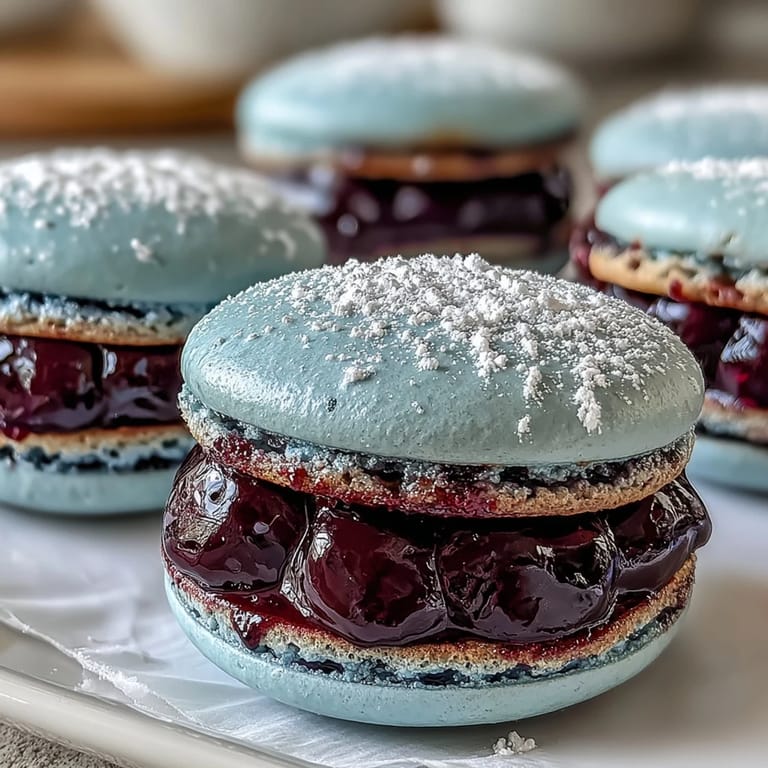
- Stir the gel coloring into the meringue until you have an even, vibrant tint throughout—don't be shy with the color, as it will fade slightly during baking.
- Fold with intention:
- Add the almond mixture in three additions, folding gently with a spatula each time until it's mostly combined before adding the next batch. The final batter should flow in thick ribbons and you should be able to draw a figure-8 without it breaking; this usually takes 40–50 careful strokes total, and stopping just before you think you're done is key.
- Pipe the shells:
- Transfer the batter to a piping bag with a 1 cm round tip and pipe circles about 3.5 cm in diameter, spacing them slightly apart. Hold the bag perpendicular to the sheet and use steady pressure; the shells will spread slightly as they rest.
- Release trapped air:
- Tap the baking sheets firmly on the counter several times to release air bubbles, then use a toothpick to pop any remaining bubbles you can see on the surface. This prevents hollow feet and cracks.
- Rest the shells:
- Let them sit at room temperature for 30–45 minutes until a thin, papery skin forms on top and they're no longer tacky to the touch. You'll feel the difference when you run your finger gently over them—they should feel almost dry.
- Bake one tray at a time:
- Preheat your oven to 150°C (300°F) and bake for 13–15 minutes, rotating the tray halfway through. The shells are done when they're set and lift gently off the parchment without sticking.
- Cool completely:
- Let them rest on the parchment for a few minutes, then transfer to a wire rack. They need to cool entirely before you touch them.
- Make the ganache:
- Chop the white chocolate finely and place it in a heatproof bowl, then heat the blackcurrant purée until it just starts to simmer. Pour the hot purée over the chocolate and let it sit for a minute before stirring gently until completely melted and smooth.
- Finish the ganache:
- Stir in the softened butter and lemon juice until fully incorporated, then let it cool at room temperature until it thickens enough to hold its shape when piped but is still soft enough to spread easily. This takes about 20–30 minutes depending on your kitchen temperature.
- Assemble the macarons:
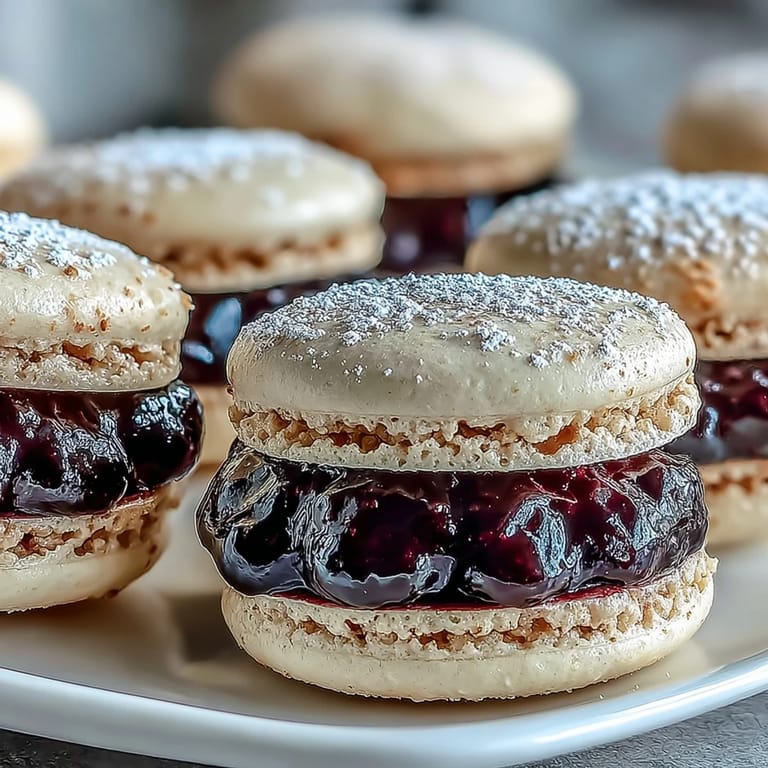
- Pair up the cooled shells by size, pipe a small amount of ganache onto one shell of each pair, and gently sandwich them together. The ganache should be visible around the edges but not oozing out.
- Let them mature:
- Place the assembled macarons in an airtight container and refrigerate for at least 24 hours—this allows the flavors to develop and the shells to soften slightly, creating that signature texture. Bring them to room temperature before serving so the chocolate ganache becomes silky again.
 Save
Save There's a moment, usually around 2 a.m. the night before I'm giving these as a gift, when I open the container and taste one straight from the fridge. The shell gives way with that gentle snap, the ganache is cool and velvety, and the black currant is bright and alive. That's when I know they're ready, and that's when I remember why I keep making them despite the precision required.
The Macaron Technique Secret
Macarons are less about having perfect ingredients and more about understanding what you're looking for at each stage. The meringue should be glossy and stiff enough that a peak holds straight up when you lift the whisk. The batter after folding should move like lava—thick but flowing. The resting period is when the magic happens; that skin that forms on top is what prevents the shells from spreading into flat discs and allows the ruffled feet to develop. Once you've felt what each stage should feel and look like, your hands remember it, and the next batch feels less like following instructions and more like a conversation with the batter.
Blackcurrant Filling Variations
While black currant is my go-to, this ganache base is adaptable if you want to experiment. Cassis purée works beautifully if you can't find blackcurrant, and I've also made these with raspberry purée strained through cheesecloth for a slightly more delicate flavor. The key is using purée rather than jam or syrup—the concentrated fruit flavor needs to shine through the white chocolate without added sugar throwing off the balance. Some people brush the finished macarons with blackcurrant liqueur mixed with edible glitter for extra shine, which looks stunning but isn't necessary; the macarons are beautiful on their own.
Storing and Serving
Once assembled, macarons keep beautifully in the fridge for up to 5 days in an airtight container, and they actually taste best after 1–2 days when the flavors have had time to mellow and marry together. You can also freeze assembled macarons for up to a month; just thaw them in the fridge overnight before serving. They're meant to be enjoyed at room temperature, so pull them out about 20 minutes before serving to let the ganache soften from its firm, cold state into something silkier and more luxurious. The slight snap of the shell against the velvety ganache is part of the experience.
- Store them in a single layer if possible, or separate layers with parchment paper to prevent them from sticking together.
- Never store macarons near foods with strong odors; they absorb flavors easily.
- If you're gifting them, arrange them in a pretty box lined with tissue paper and they become an immediate centerpiece on someone's table.
 Save
Save Making macarons is an act of patience that teaches you something about precision and care. They remind you that small details matter, and that good things are worth the wait.
Recipe FAQ
- → Why must macarons rest before baking?
Resting allows a skin to form on the surface of the shells. This skin prevents the meringue from spreading too much in the oven and helps create the signature ruffled feet while maintaining a smooth, crack-free top. The resting period typically takes 30–45 minutes until the shells are no longer tacky.
- → Can I make blackcurrant purée at home?
Yes, simply blend fresh or frozen blackcurrants until smooth, then press through a fine-mesh sieve to remove the seeds. You can cook the purée briefly to thicken it if desired. For convenience, frozen blackcurrant purée works beautifully and saves preparation time.
- → What's the purpose of aging egg whites?
Aging egg whites in the refrigerator for 24–48 hours allows them to lose some moisture, resulting in a more stable meringue with better volume. This stability is crucial for achieving smooth shells with proper feet and preventing hollows or cracked shells during baking.
- → Why do my macarons have hollow shells?
Hollows typically occur from under-mixed batter, over-beaten egg whites, or oven temperature that's too high. The batter should flow in thick ribbons and hold a figure-8 pattern. If the meringue is too stiff or the batter isn't folded enough, air pockets remain trapped, creating hollows as the shells bake.
- → How should I store finished macarons?
Place assembled macarons in an airtight container and refrigerate for at least 24 hours to allow flavors to mature and texture to soften. They can be refrigerated for up to 5 days. Bring to room temperature 30 minutes before serving for the best texture and flavor experience.
- → Can I substitute the blackcurrant filling?
Absolutely. This ganache technique works beautifully with other fruit purées like raspberry, passion fruit, or lemon. Adjust the white chocolate quantity slightly depending on the acidity of the fruit—more acidic fruits may benefit from slightly more chocolate to achieve the proper balance.